Material Handling Safety: Bridging Innovation and Protection
Author: Haley Gates – Director, EHS at KPI Solutions
The material handling industry stands at a pivotal crossroads. As Director of Environmental Health and Safety at KPI Solutions, I’ve witnessed firsthand how rapid technological advancement is reshaping our operations. Yet with each innovation comes a fundamental question: Are we implementing technology in ways that genuinely enhance safety, or are we inadvertently introducing new hazards?
The Material Handling Industry’s (MHI) association has identified a critical need to bridge gaps between innovation and protection, ensuring that new technologies enhance safety rather than complicate it. This imperative isn’t about resisting progress, but guiding it responsibly.
Why Now?
The material handling industry is evolving at an unprecedented pace. The global warehouse robotics market reached $14.7 billion in 2024 and is projected to grow at 23.1% annually through 2034, according to GM Insights. Over 30% of warehouses have integrated robotics into their operations, up from just 20% in 2021. Autonomous mobile robots now navigate aisles alongside human workers, while automated systems operate at speeds that would have seemed impossible a decade ago.
Research shows that human-cobot teams are 85% more productive than teams composed solely of robots or humans. But each innovation also introduces complexity that can create safety blind spots. The safety protocols that served us well in conventional environments may prove insufficient when humans and autonomous systems share floor space, making split-second decisions that affect each other.
Understanding the Stakes
The statistics are sobering. National Safety Council analysis of Bureau of Labor Statistics data for 2021 and 2022 shows that more than 2 million days away from work were a result of injuries, with back-related injuries leading the way. Transportation and warehousing experienced the highest lost-time injury and illness rate per 10,000 workers.
Yet here’s the opportunity: warehouses that have adopted automation have seen a 25% reduction in workplace injuries alongside a 35% increase in productivity. These results prove that safety and efficiency are not competing priorities but complementary goals that create superior outcomes when pursued together.
Redefining Safe and Efficient
We face an extraordinary opportunity to redefine what “safe” and “efficient” truly mean when working with robotics in warehousing. In reality, safety rules are inconsistent and often intentionally vague. Safe and efficient are sometimes positioned as competing priorities; a false dichotomy that has cost our industry dearly.
True safety integration means designing protection into systems from the ground up. It means involving safety professionals in technology selection from day one and recognizing that the safest operation is often the most efficient one, because incidents and uncertainty drain productivity.
This requires intentionality. We must establish clear frameworks for evaluating new technologies on both operational capabilities and safety implications. Industry standards like ISO 10218:2011 for industrial robots and ANSI/RIA R15.08.2020 for autonomous mobile robots provide crucial foundations. We need robust testing protocols that simulate real-world conditions, including the unexpected situations where accidents typically occur.
The Human Element Remains Central
As we embrace automation, we cannot lose sight of people. Workers remain at the heart of material handling operations as operators, supervisors, maintenance technicians, and decision-makers. Technology should empower these individuals, not diminish their agency.
The National Institute for Occupational Safety and Health recommends a maximum weight of 51 pounds for manual lifting, yet countless workers exceed this threshold daily. Automation offers a path to eliminate hazardous and repetitive manual tasks while creating new roles focused on technology management and system optimization. Research shows that 62% of inventory fulfillment issues stem from human error in manual processes, issues that proper automation can address while protecting workers from physical strain.
This means designing intuitive human-machine interfaces and investing in comprehensive training that evolves alongside technology. The goal is building a culture where continuous learning, hazard recognition, and proactive risk management are embedded in daily practice.
Role Specialization and Sharing Warehouse Space
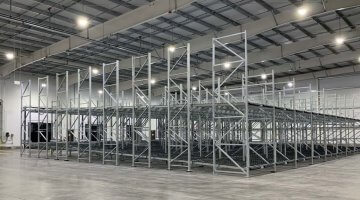
Not every space in a warehouse needs to be shared between people and machines. In fact, the most productive facilities often engineer the operation for role specialization. For example, Autonomous mobile robots (AMRs) work here, humans work there. The interfaces between zones are clean, predictable, and governed by well-defined handoff processes.
In dense storage zones, goods-to-person operations, or continuous loop transport systems, spatial specialization for automation clarifies boundaries. We are seeing success with intentional boundaries between humans and robots, such as fenced zones. Fencing draws a deliberate boundary between high-speed robotic movement and human workspaces. Read more about fencing use with AMRs in this recent KPI Solutions Blog.
Moving Forward Together
The material handling industry’s safety challenges require collaboration across the entire ecosystem: from equipment manufacturers, end users, safety professionals, regulators, and industry associations like MHI.
The warehouse robotics market is projected to reach $117.3 billion by 2034. But realizing this potential will only happen if we implement technologies with wisdom, foresight, and unwavering commitment to worker safety. This is our moment to prove that advancement and protection are complementary goals that, pursued together, create truly world-class operations.
References
Material Handling Injuries:
Warehouse Automation Growth:
- Global warehouse robotics market reached $14.7 billion in 2024, projected to grow at 23.1% CAGR to reach $117.3 billion by 2034 (GM Insights) Global Market Insights
- Over 30% of warehouses will have integrated robotics by 2024, up from 20% in 2021 Meteror Space
Safety & Efficiency Improvements:
- Warehouses with automation saw a 25% reduction in workplace injuries and 35% increase in productivity Meteor Space
- Automated warehouses achieve 99% inventory accuracy Cyngn
- Human-cobot teams are 85% more productive than teams of only robots or only humans Cyngn
Categories (tags):