
Key Metrics

40+
WMS Platforms Supported
SOC 2
Certified & Compliant
100%
Technology-Neutral Approach
150%
Fulfillment Rate Increase (Client Result)

Your Integration’s Success Is Determined Before the First Bolt Is Turned

Why Planning is Everything

Warehouse system integration is not simply a construction project — it is an organizational transformation. The gap between a smooth Go-Live and a costly overrun often comes down to a single variable: the rigor of the planning process that preceded it.

At KPI Solutions, we believe meticulous pre-project planning is the single greatest driver of integration success. Our Project Execution framework is a consistent, repeatable methodology designed to minimize risk, maximize transparency, and ensure every phase of your warehouse integration delivers measurable results. Whether you are deploying a new conveyor network, a high-density AutoStore™ system, autonomous mobile robots (AMRs), or a complex WMS/WES integration, our approach remains the same — disciplined, data-driven, and client-first.

As an independent systems integrator, KPI is not locked into any single vendor’s ecosystem. Our technology-neutral stance means we recommend what is truly best for your operation, not what earns us the highest margin. That objectivity starts at planning and never stops.
Many supply chain integrators arrive on-site with a scope, a schedule, and a purchase order. Fewer arrive with a deeply validated operational design, a simulation-backed risk assessment, and a cross-functional alignment strategy that includes your IT, operations, finance, and executive teams. KPI does the latter — every time.

Our Industry 4.0 design philosophy demands that we analyze every integration challenge from multiple viewpoints before recommending a path forward. We evaluate your current SKU profile, throughput targets, labor model, facility constraints, software ecosystem, and five-year growth projections before a single line item appears on a project plan. This is what on-time, on-budget integration actually looks like in practice.

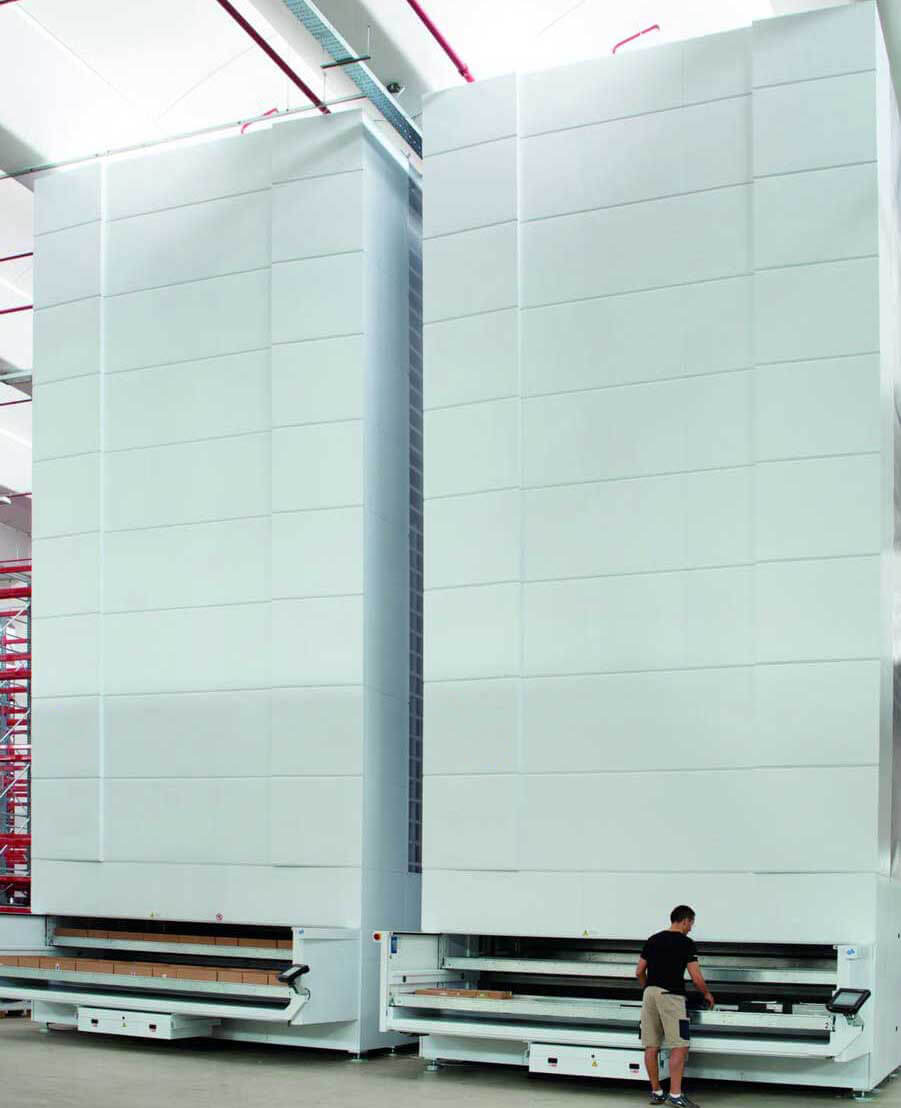
Modula Vertical Lift Module

Six Phases. One Accountable Partner. Zero Ambiguity.

The KPI Integration Framework

Our Project Execution framework guides every client through a structured lifecycle — from the first discovery call to long-term operational optimization. Each phase is designed to build confidence, maintain momentum, and protect your investment.

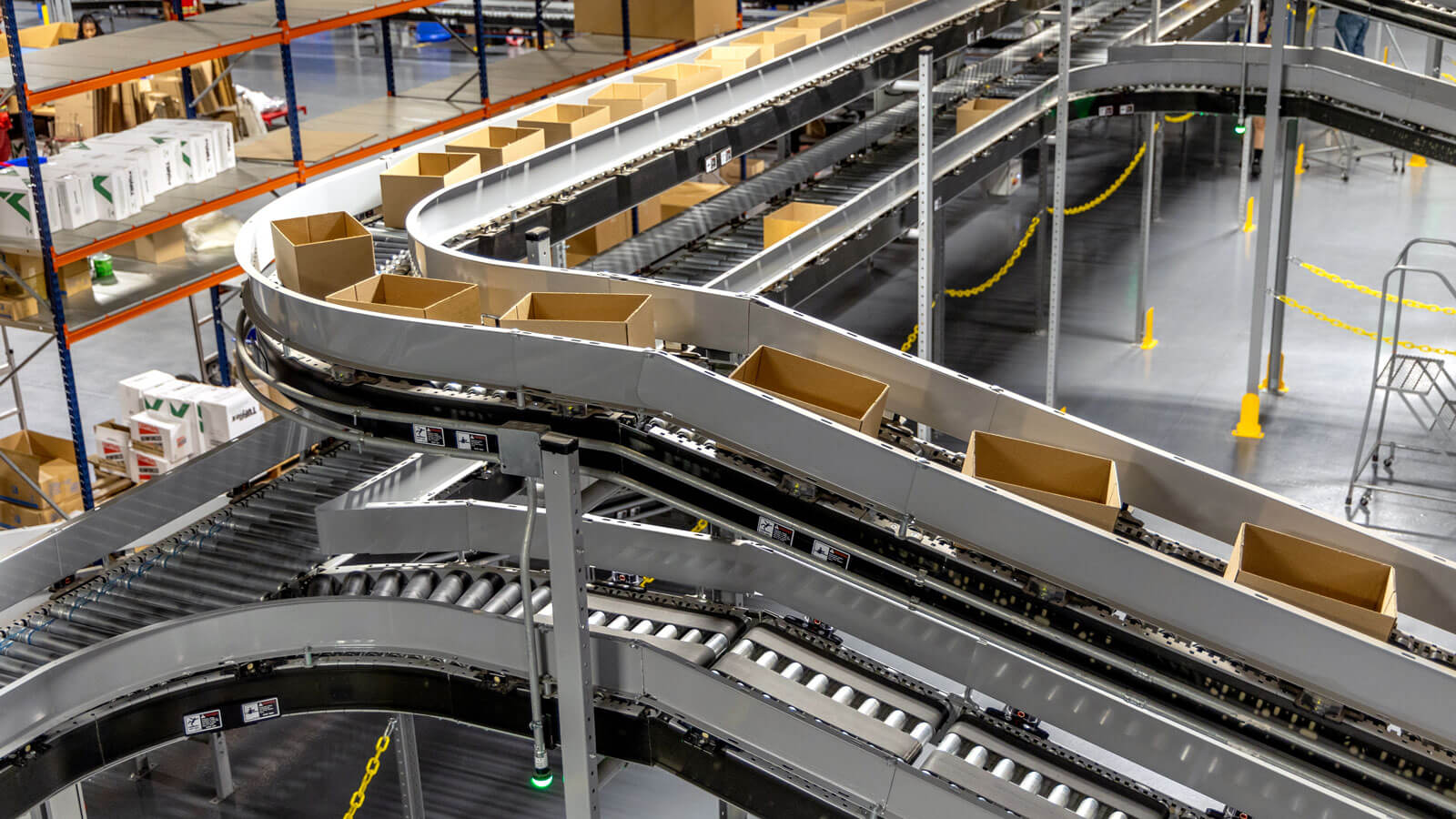
Ecommerce Warehouse WES

Success starts with understanding your operation at a granular level. Our team conducts a detailed analysis of your warehouse requirements, volumes, timelines, and resources to create a robust integration roadmap tailored to your unique goals. We perform a comprehensive operational assessment — examining current workflows, labor dependencies, technology gaps, and facility constraints — before a single recommendation is made. From resource allocation to stakeholder alignment, this phase lays the foundation for every decision that follows.

We don’t just design one solution — we evaluate multiple alternatives and model the merits of each, including the baseline cost and risk of doing nothing. Our engineering team develops engineered concept designs that reflect your throughput capacity, SKU profile, storage density, and scalability requirements. By comparing dynamic scenarios against your operational realities, we ensure the system design you choose is right for today and flexible enough for tomorrow. All designs are produced with a technology-neutral lens, free from vendor bias.

Before any capital is committed, KPI leverages advanced, time-based warehouse simulation modeling to validate performance under real-world conditions. Our simulations synchronize material handling equipment, warehouse management software (WMS), and workforce models to surface inefficiencies, identify bottlenecks, and pre-empt risks that typically surface only during implementation. Clients who invest in simulation routinely avoid 30–50% of the risks inherent in warehouse automation projects. This phase is how we protect your capital and your timeline simultaneously.

Our experienced project management team oversees every facet of on-site implementation — coordinating construction, material handling equipment installation, controls commissioning, and full software integration across your WMS, WES, and ERP platforms. With experience integrating more than 40 Tier 1 and Tier 2 WMS systems, KPI brings genuine technical depth to even the most complex multi-system environments. Our proprietary Opto WES platform provides a single point of connection between automation assets and upstream systems, simplifying security, maintenance, and data flow from day one.

Before your warehouse becomes fully operational, KPI rigorously tests every system, process, and integration point to confirm optimal performance under real operational conditions. We validate throughput targets, software behavior, exception handling, and staff workflows — closing every gap identified during simulation and engineering review. Our Go-Live process is methodical and transparent, with clear escalation paths and a dedicated KPI team on-site to manage the transition. Clients experience confident, clean go-lives rather than stressful surprises.

Integration doesn’t end at Go-Live — it evolves. KPI’s LifeTime Services program delivers ongoing maintenance, resident engineering support, spare parts management, system upgrades, and performance optimization to keep your integrated warehouse running at peak efficiency year over year. As your business grows and your distribution demands shift, KPI remains your strategic partner, identifying new opportunities for automation, process improvement, and scalability enhancement. This is the long-term commitment that distinguishes a true partner from a one-time vendor.

The Capabilities That Drive Integration Excellence

What Makes KPI Different

Technology-Neutral Systems Integration

KPI is an independent integrator — not a captive arm of any equipment manufacturer. We source best-of-breed technology from across the automation landscape, including conveyors, sortation, AMRs, AutoStore™, ASRS, AGVs, robotic picking, and vertical lift modules, then blend them into a cohesive system optimized for your operation. Your outcome drives our recommendation, not our supply agreements.

Data-Driven Planning & Simulation

Every KPI integration plan is backed by data — not intuition. Our consulting team uses advanced warehouse simulation, engineered labor standards, and operational modeling to produce designs that perform under real-world volume pressures. We test before we build, which means clients avoid expensive change orders and costly redesigns post-implementation.

Intelligent Software Integration via Opto WES

KPI’s proprietary Opto Warehouse Execution System provides a unified software layer that orchestrates labor, automation, and inventory in real time. With native connectivity to more than 40 WMS platforms and full ERP integration capability, Opto eliminates the fragmented point-to-point integration that plagues many warehouse automation deployments. One system. One point of accountability. Maximum uptime.

SOC 2 Certified Security & Data Integrity

As warehouse operations become increasingly software-driven, data security is not optional. KPI Solutions has achieved SOC 2 compliance, confirming that our processes, security controls, and data handling practices have been independently validated. For operations evaluating enterprise-grade integration partners, this certification reduces risk and ensures your operational data is protected throughout every phase of the project lifecycle.

Scalable, Modular Integration Design

Today’s distribution demands look nothing like those of five years ago — and tomorrow’s will look different still. KPI designs integration solutions with modularity and scalability at their core. Whether you need to expand capacity, add new automation technologies, or pivot to a new fulfillment model, your integrated system is built to grow with you, not against you.

How KPI Solutions Compares to Other Supply Chain Systems Integrators

Competitive Landscape

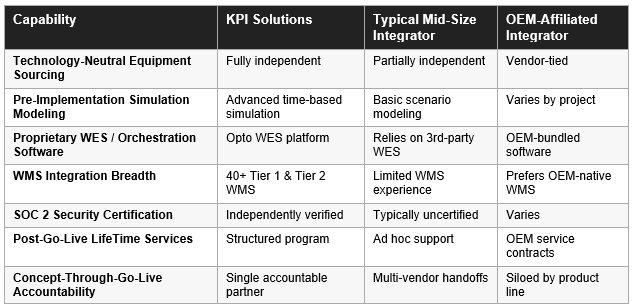
When evaluating warehouse systems integration partners, the differences in process depth, technology independence, and long-term support philosophy matter enormously. Here’s how KPI Solutions stacks up against common mid-size integration competitors.

LP Table

Purpose-Built Integration for Your Sector

Industries We Serve

KPI Solutions brings vertical-specific expertise to every integration engagement. Our teams understand that a pharmaceutical distribution center operates under completely different constraints than an e-commerce fulfillment hub or a beverage distributor — and we plan accordingly.

We have delivered complex, multi-technology warehouse integrations across sectors including e-commerce and direct-to-consumer fulfillment, healthcare and pharmaceutical supply chains, food and beverage distribution, retail and omnichannel logistics, and third-party logistics (3PL) operations. In each case, our system integration planning process was calibrated to the regulatory requirements, throughput profiles, and labor dynamics unique to that vertical. This sector-specific intelligence reduces design risk and accelerates time to ROI on your automation investment.

No matter the industry, our integration planning process begins and ends with the same core commitment: transparency with our clients at every step, and measurable operational outcomes that justify your investment.

Ready to Start Your Integration Planning?

Connect with a KPI Solutions integration specialist to discuss your warehouse requirements, operational goals, and timeline. We’ll help you build a roadmap to a more efficient, scalable distribution operation.