A WES Doesn’t Have to Be Big to Be a WES
There’s a persistent myth in warehouse automation circles: that a Warehouse Execution System only counts once it’s orchestrating a sprawling, multi-technology operation: conveyors, AS/RS, AMRs, sortation, and a small army of workstations, all humming together under one platform. If you’re only running one piece of equipment, the thinking goes, you don’t really need a WES. A WMS and some basic controls will do.
That thinking gets the definition backward. A WES isn’t defined by how much equipment it touches. It’s defined by what it does: managing real-time warehouse activity by orchestrating workflows, labor, and automation to optimize throughput. That job doesn’t change based on scale. Whether you’re synchronizing twelve subsystems or a single automated cell, something still has to sequence tasks, make real-time decisions, and keep work flowing efficiently. That “something” is a WES, full stop.
The Single-Module Test Case: A 4-Way Shuttle System
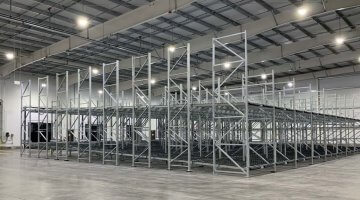
A 4-way shuttle system is a good example precisely because it can exist as a standalone investment. It’s a high-density pallet storage and retrieval solution: battery-powered shuttles that travel longitudinally and laterally across a racking grid, paired with lifts for vertical movement between levels. A facility might deploy just one of these systems to solve a specific space problem: more pallet positions in the same footprint, less forklift travel, tighter inventory control. No conveyor sortation, no goods-to-person picking, no robotic piece-picking cells. One module, one job.
Even here, a WES earns its place. Inside a 4-way shuttle deployment, pallets arrive through infeed conveyors, get verified for dimension, weight, and ID, and then need a storage location assigned based on rules like SKU velocity, temperature zone, or order priority. Multiple shuttles are operating on the same grid simultaneously, which means someone, or something, has to route them to avoid congestion, balance which shuttle takes which task, and decide in real time which pallet moves next when priorities shift. That’s not a WMS function. A WMS tells you what needs to happen. It doesn’t tell twelve shuttles, in the moment, how to get there without running into each other.
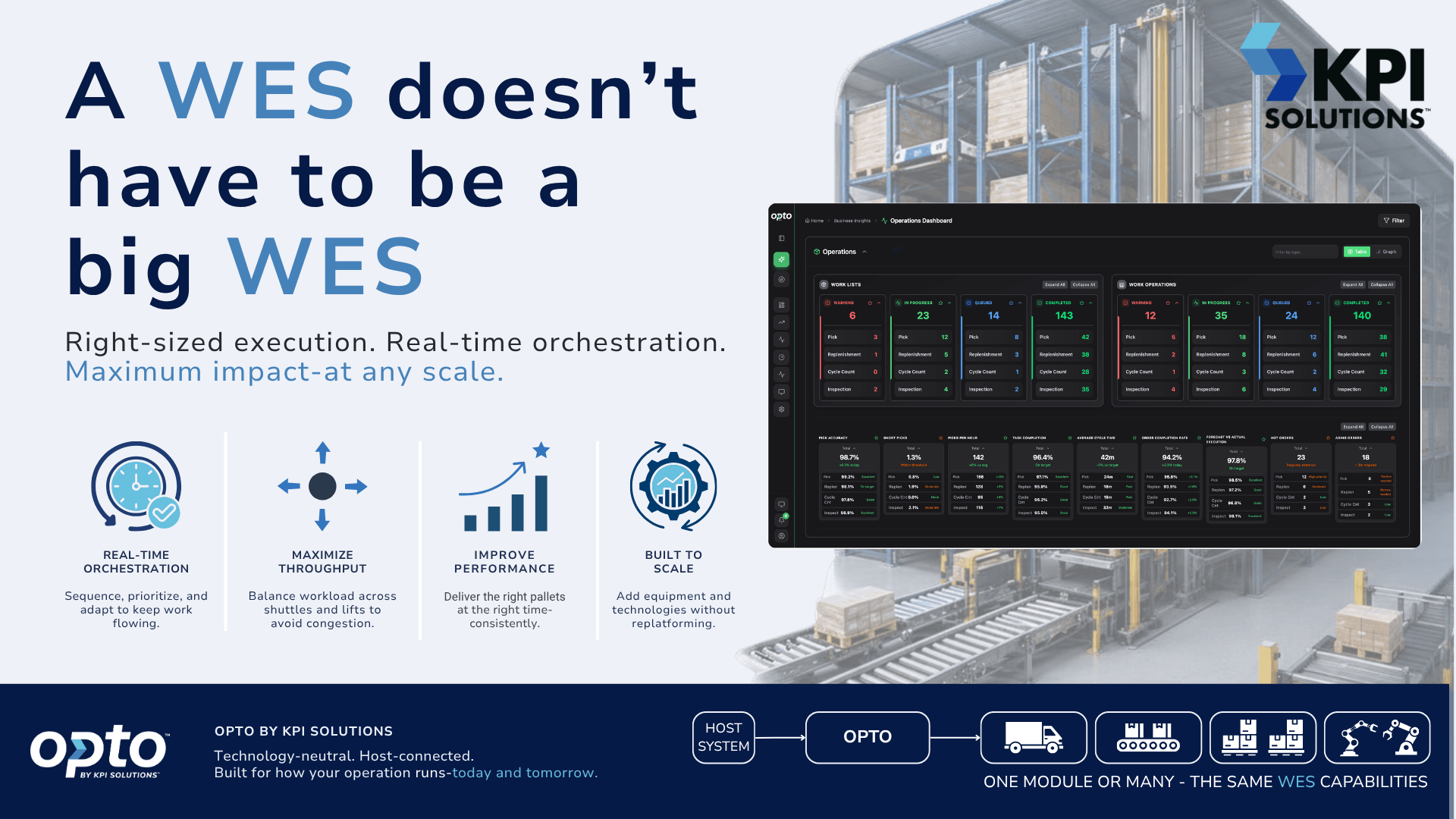
This is where Opto™ Warehouse Execution System (WES), KPI Solutions’ warehouse execution software, does its work even in a single-module deployment. Opto sits at the execution layer and handles the things a WMS was never built to do: sequencing and prioritizing tasks as they compete for the same shuttles and lifts, balancing workload across the fleet so no single unit becomes a bottleneck, and adjusting dynamically as order volume spikes or dips. It gives real-time visibility into what every shuttle and lift is doing, so if something slows down, it’s visible immediately instead of surfacing as a missed shipment three hours later. And because Opto is technology-neutral, it acts as one point of connection between the WMS above and the automation below, regardless of how many, or how few, pieces of equipment sit underneath it.
The difference this makes to overall flow is concrete. Without an execution layer, a single shuttle system still runs, but it runs on static logic: fixed rules, first-in-first-out sequencing, no real ability to reprioritize when an urgent order lands or a shuttle goes down for a charge cycle. With Opto directing it, the system responds to what’s actually happening on the floor right now, reallocating tasks, resequencing retrievals, and keeping throughput steady even as conditions change. That’s the gap between automation that moves pallets and automation that moves the right pallets at the right time.
One Connection or Several: Right-Sizing is the Goal
Here’s the part that actually should drive the buying decision: a 4-way shuttle system is inherently modular. Capacity and throughput scale by adding shuttles, lifts, or workstations incrementally, rather than by ripping out infrastructure and starting over. Real deployments range from a dozen shuttles managing 12,000 pallet positions to over a hundred shuttles managing well beyond 100,000. Same underlying architecture, just more of it.
If the execution layer only gets deployed once the operation is “big enough,” you end up bolting on orchestration logic after the fact, on top of a system that’s already grown past the point where static rules can keep up. Deploying Opto alongside even a single shuttle system from day one means the execution layer scales in lockstep with the equipment. Add a second shuttle system, a conveyor sortation line, or a goods-to-person cell next year, and Opto absorbs it into the same orchestration model. No redesign, no replatforming, no gap where the operation temporarily runs blind while a “real” WES gets bolted on.
This is really the core point: a WES isn’t a reward for complexity, and it isn’t just insurance for future growth either. Whether it’s orchestrating one connection or fifty, the job is the same: right-size execution to what the operation actually needs today and deliver ROI at that scale. Task planning, workload balancing, dynamic decision-making: that logic pays for itself running a single shuttle system just as much as it does across twenty integrated technologies. A one-module deployment isn’t a WES-in-waiting, incomplete until it grows into something bigger. It’s a WES already doing its job, sized correctly for the operation it’s running.
So whether an operation is running a single 4-way shuttle system or a fully integrated automation environment spanning multiple technologies, the question isn’t whether a WES is warranted or how much scale it justifies. It’s whether the execution layer in place is right-sized for what the operation needs right now. Opto is built to deliver that fit at any scale: efficient and sufficient at one module, and just as capable of expanding if the operation eventually calls for it. A WES doesn’t need to be huge to be essential. It just needs to fit the job in front of it.
Categories (tags):