
Effective, efficient, and system-agnostic solutions for your unique needs.

Effective, efficient, and system-agnostic solutions for your unique needs.

End-to-end solutions, from consulting to LifeTime Services.

Cohesive collaboration from day one.
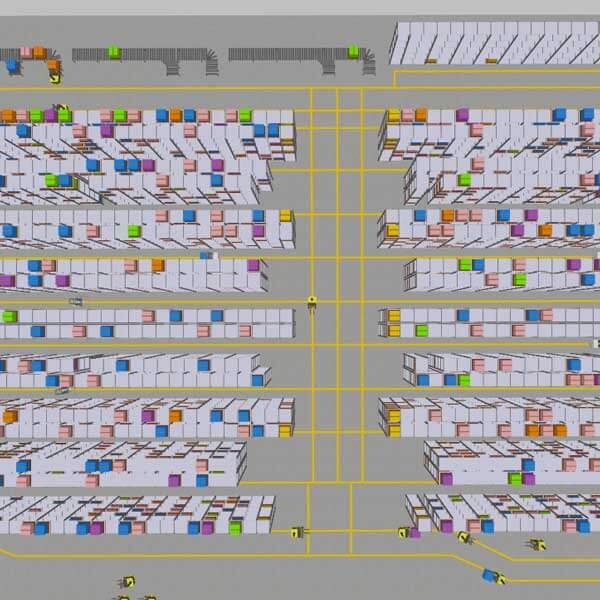
Our warehouse simulations leverage advanced, time-based modeling to offer unparalleled insight into your distribution operations. By comparing dynamic workloads against dynamic conditions, we enable a deeper understanding and optimization of both staffing levels and process efficiency, ensuring your operational design aligns with real-world demands.
 Synchronization Success: Top-performing facilities sync material handling, warehouse management software, and human methods in their distribution centers.
 Simulation Strategy: Simulation can reveal inefficiencies before opening a new distribution center and optimize efficiency, accuracy, and speed.
 Efficiency Unlocking: Simulation provides insight into distribution center efficiency, risk mitigation, and troubleshooting.
 |
 |
 |
Proactive
|
Operational
|
Strategic
|
 |
 |
 |
Informed
|
Cost
|
Enhanced
|
In addition to traditional methods, our simulations now compare dynamic workloads against other dynamic conditions, providing a more accurate reflection of real-world operations. This advanced approach helps calculate downtime due to congestion, empty pick locations, and assess optimal staffing levels.
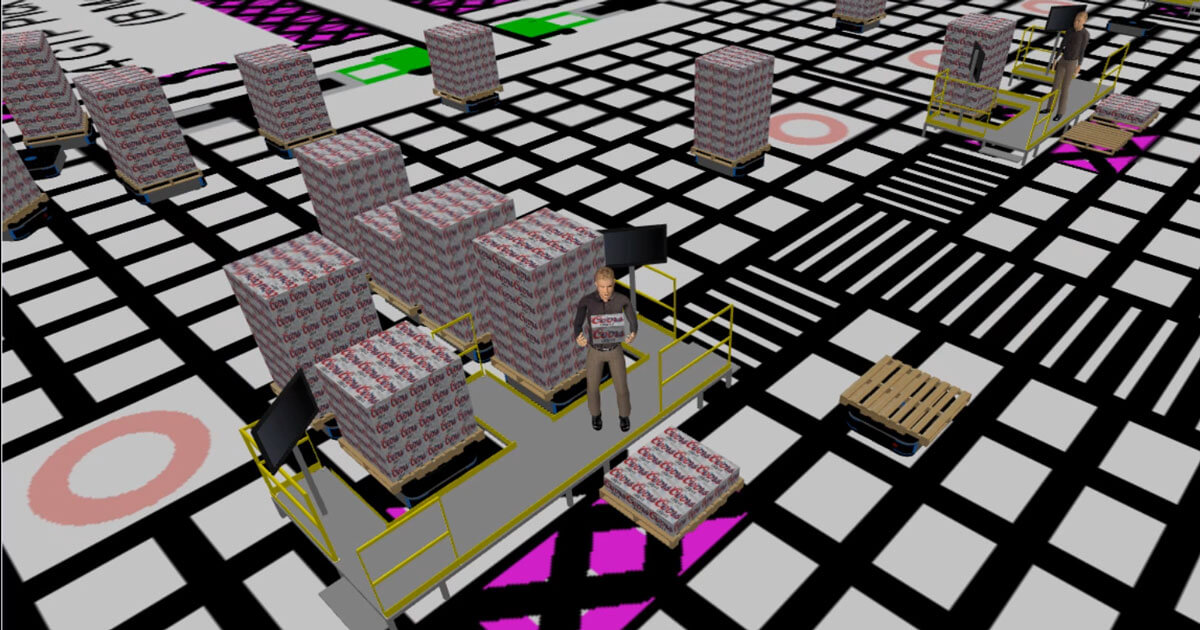
Imagine the substantial savings and assurance of avoiding up to 50%, 40%, or even 30% of potential risks inherent in warehouse automation installations. How much could you save by anticipating and resolving these issues before they arise? Our strategic simulations make this possible.


1. What is warehouse simulation and how does it work?
Warehouse simulation creates a computer-based model, or “digital twin,” of your distribution center to test operational changes virtually. It uses your historical data and facility constraints to predict how new layouts, automation, or process changes will perform before implementation.
2. Why is simulation better than using static spreadsheets for warehouse planning?
Static spreadsheets only provide averages and “best-case” scenarios, whereas simulation accounts for the variability and randomness of real-world operations, such as equipment downtime, worker fatigue, and irregular order spikes. This dynamic approach identifies “clashes” and bottlenecks that spreadsheets simply cannot detect.
3. When is it necessary to invest in a warehouse simulation?
Simulation is essential for major capital investments, such as installing new conveyor systems, implementing AS/RS, or redesigning large facilities. It is also effective for stress-testing current operations against projected growth to identify potential breaking points.
4. How does simulation help in de-risking warehouse automation projects?
Simulation acts as a “virtual proof of concept.” By running your real SKU data through a virtual model of the proposed automation, we can verify if the equipment will actually meet the vendor’s promised throughput. This prevents the multi-million dollar mistake of buying a system that underperforms once installed.
5. What is a “Digital Twin” in the context of warehousing?
A Digital Twin is a live, virtual replica of your warehouse that updates as real-world data changes. It allows managers to test what-if scenarios, such as “What if we double our order volume tomorrow?”, and see the impact on labor and equipment without disrupting operations.
6. Can simulation help optimize warehouse staffing and labor levels?
Yes. Simulation models dynamic workloads against labor availability to determine the required headcount for each shift and zone. This helps you balance overstaffing costs and the risks of understaffing.
7. What kind of data is required to build an accurate warehouse simulation?
An accurate model requires your facility’s CAD drawings, SKU dimensions, historical order profiles, equipment specifications (speeds/acceleration), and labor performance rates. The more granular the data provided, the more reliable the simulation’s predictions will be.
8. What is the difference between simulation and emulation?
Simulation is used for high-level planning and design to predict throughput and flow. Emulation is a deeper “stress test” where the virtual model is connected to the actual software (WMS or PLC) that will run the warehouse, ensuring the code works perfectly before it is deployed on the floor.
9. How long does a warehouse simulation project typically take?
A standard simulation project can take anywhere from 4 to 8 weeks. This timeline includes data collection, model building, “base case” validation (ensuring the model matches your current reality), and then running various optimization scenarios to find the best solution.
10. What are the typical outputs and results of a simulation study?
You receive a detailed report including heat maps of congestion, throughput analysis by zone, equipment utilization rates, and a 3D visualization of the proposed operation. Most importantly, you get a “go/no-go” recommendation based on hard data rather than assumptions.
Whether it’s risk mitigation, unlocking higher levels of efficiency, or troubleshooting,
our simulations provide a cutting-edge view into the intricacies of your distribution center or warehouse.
"*" indicates required fields