The Benefits of a Cube-Based ASRS: Density, Speed, and Scale
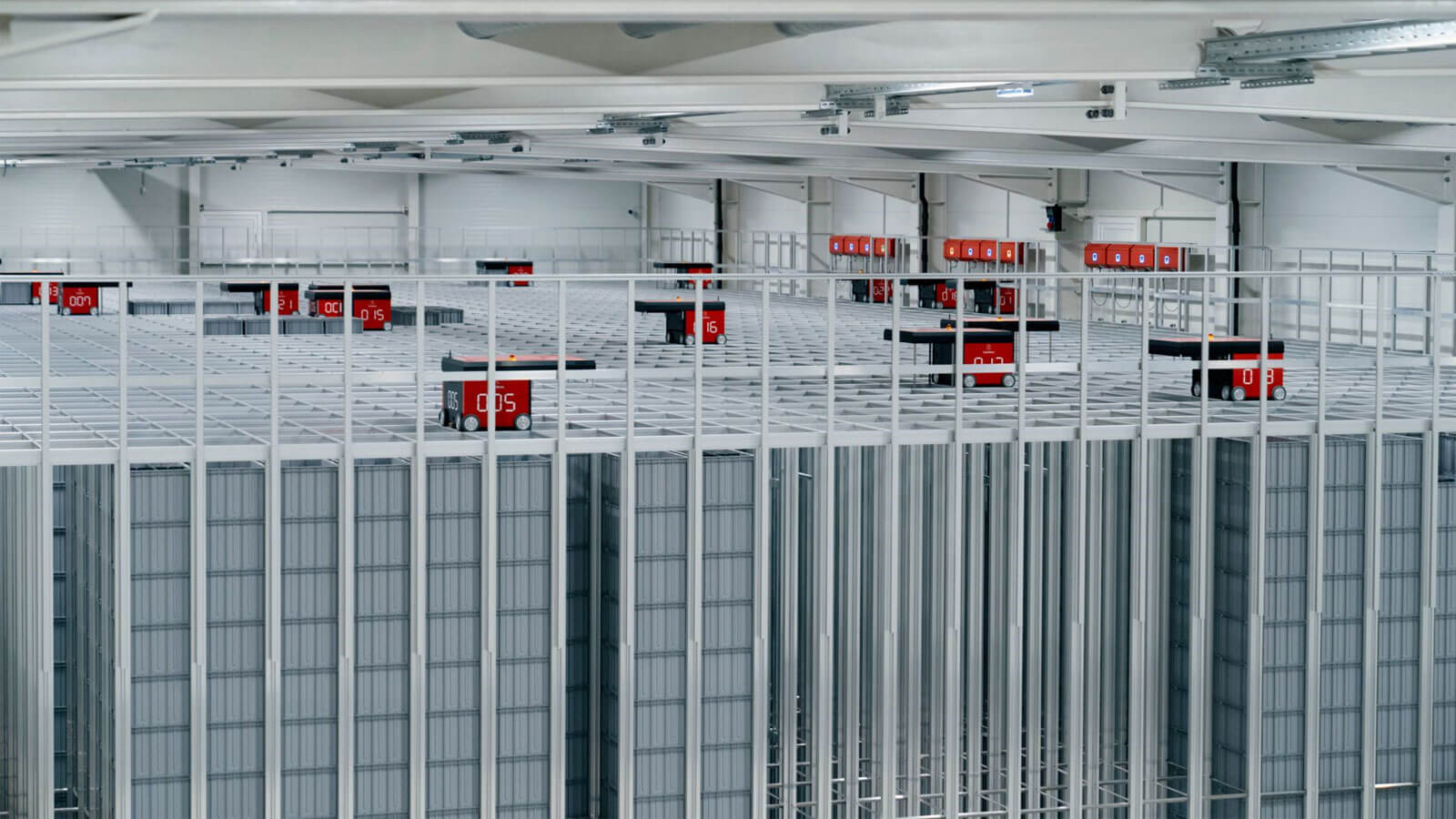
Warehouse space is expensive, labor is hard to find, and order volumes keep climbing. Those three pressures have pushed automated storage and retrieval systems from a niche investment to a mainstream tool, and one design in particular has drawn intense interest: cube-based storage. By packing inventory into a dense grid and using robots to retrieve it, a cube-based ASRS can hold far more product in the same building while sending fewer people on long trips across the floor.
This guide explains what a cube-based ASRS is, the problems it solves, and the specific benefits that make it worth considering, along with an honest look at where it fits best.
What Is an Automated Storage and Retrieval System?
An automated storage and retrieval system, or AS/RS, is a computer-controlled system that automatically stores and retrieves inventory from defined locations. In place of operators walking aisles to find product, the system brings goods to a stationary workstation, which raises storage density, improves inventory accuracy, and speeds up throughput. AS/RS is a family of technologies rather than a single machine, and the main types are usually grouped by the load they handle:
- Unit-load AS/RS for full pallets and heavy loads.
- Mini-load AS/RS for totes, trays, and cases.
- Vertical lift modules that deliver trays to an operator at a waist-high window.
- Pallet shuttles for deep-lane, high-density pallet storage.
- Cube-based AS/RS that stores bins in a dense grid and uses robots to retrieve them.
Each suits different load sizes, throughput targets, and footprints. The cube-based category is the one drawing the most attention in piece-picking and e-commerce operations, and it is the focus here.
What Makes Cube-Based Storage Different
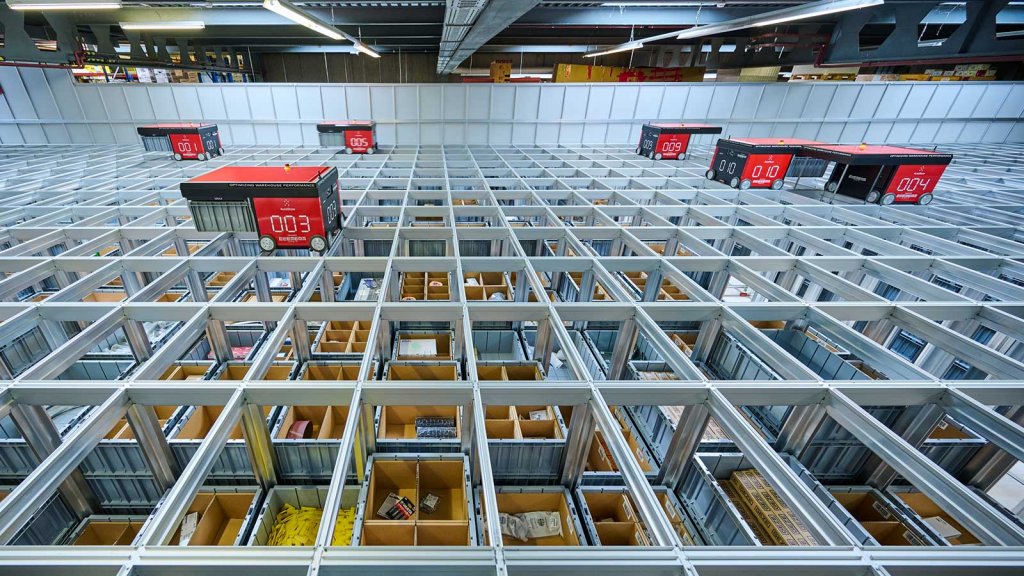
A cube-based ASRS stores inventory in bins stacked directly on top of one another inside an aluminum grid, with no aisles or shelving between them. Robots travel across the top of the grid, lift the bin that holds the needed item, and deliver it to a port where an operator picks. Because the bins nest together and the aisles disappear, the system reaches a storage density that conventional racking cannot approach. The grid can be shaped around building columns and irregular walls, and it can be extended by adding bins, robots, and ports as needs change.
This design is the reason cube-based systems have become popular where space is at a premium. They convert unused vertical and floor space into working storage, which is valuable in almost every market and essential in high-cost urban ones.
The Pressures a Cube-Based ASRS Addresses
Most operations look at cube storage because they are feeling one or more familiar pressures:
- Space is running out. A large share of existing warehouse stock was built for an earlier era. CBRE reports that most bulk warehouses built before 2000 have clear heights under 30 feet, below the minimum many modern operations want (CBRE). Even in taller buildings, conventional racking leaves much of the cubic space unused, a gap industrial real estate guidance highlights between clear height and usable storage (Link Logistics).
- Labor is scarce, and travel is wasteful. In a manual pick operation, walking consumes a large share of every shift. Cube storage removes that travel by bringing bins to the operator.
- Accuracy and peak demand. Manual processes strain under peak volume, and errors climb. Automated retrieval holds accuracy steady as volume rises.
Key Benefits of a Cube-Based ASRS
The advantages of cube-based storage cluster around density, productivity, and adaptability.
- Exceptional storage density. By eliminating aisles and stacking bins tightly, a cube-based ASRS stores substantially more inventory in the same footprint than conventional racking, which can defer or avoid a costly building expansion.
- Higher picking productivity. As a goods-to-person system, it brings items to the operator, cutting the travel that dominates manual picking and raising picks per hour per worker.
- Reduced labor dependence. Fulfilling more orders with fewer people eases the strain of a tight labor market and lowers reliance on large seasonal workforces.
- Strong inventory accuracy. Robotic storage and retrieval track every bin movement, which tightens inventory control and reduces mis-picks.
- Modular scalability. Capacity grows by adding bins, robots, and ports, so the system scales in step with demand instead of requiring a single large build.
- Built-in redundancy. Many systems run a fleet of robots, so if one needs service, the others keep working, which supports uptime through peak.
- Better ergonomics and safety. Operators work at a consistent, ergonomic port in place of bending, reaching, and walking for miles, which can improve retention and reduce injury risk.
- Efficient use of energy and footprint. Compact design and lightweight robots keep operating demands modest relative to the throughput delivered.
Is a Cube-Based ASRS Right for Your Operation?
Cube-based storage is powerful, though it fits some profiles better than others. It tends to excel with large numbers of small-to-medium items, each-level and piece picking, high order volumes, and buildings where space is constrained. Operations with very large or heavy loads, or with a small and slow-moving SKU base, may be served better by another AS/RS type or a hybrid design that combines technologies.
The honest answer for any operation comes from data. Order profiles, SKU velocity, cube movement, growth projections, and the physical building all shape whether cube storage is the right anchor, a supporting piece, or a poor fit. A proper analysis models the operation before any capital is committed.
The Software That Makes It Work
Hardware density means little without intelligent control. A warehouse execution system orchestrates the robots, ports, and inventory in real time, sequencing work, balancing the system against the rest of the operation, and adapting as order patterns shift through the day. Strong software is what turns a dense grid into a responsive, high-throughput operation, and it is what lets a cube-based ASRS work smoothly alongside conveyors, mobile robots, and manual zones.
How KPI Solutions Helps
KPI Solutions designs automated storage and retrieval systems and goods-to-person solutions around each operation rather than a fixed product. We start with your data, model your order and SKU profiles, and recommend the storage approach, or blend of approaches, that fits your volumes, footprint, and growth. Because our approach is technology-neutral, the recommendation follows your requirements, and our LifeTime Services keep the system performing well after go-live.
Frequently Asked Questions
- What is a cube-based ASRS? It is an automated storage and retrieval system that stores inventory in bins stacked in a dense grid, with robots traveling across the top to retrieve bins and deliver them to an operator. It offers very high storage density and goods-to-person picking.
- How much space can cube storage save? Savings vary by operation, but because the design removes aisles and uses vertical space fully, cube storage typically holds far more inventory in the same footprint than conventional racking. A site-specific analysis gives a reliable estimate.
- Does a cube-based ASRS help with labor shortages? Yes. By bringing goods to the operator and removing most walking, it increases picks per hour per worker, so an operation can fulfill more orders with fewer people.
- Can it scale as my business grows? Cube-based systems are modular. Capacity expands by adding bins, robots, and ports, which lets the system grow in step with demand.
- What kinds of products suit cube storage best? It works best for large assortments of small-to-medium items and piece or each picking, common in e-commerce and retail fulfillment. Very large or heavy loads usually call for a different AS/RS type.
Ready to See Whether Cube-Based Storage Fits Your Operation?
Connect with the KPI Solutions team for a data-driven assessment.
Categories (tags):