How AI is Transforming Food, Beverage, and Grocery Fulfillment
Author: Manish Sharma – Chief Product & Technology Officer at KPI Solutions
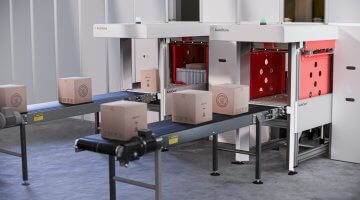
AI-driven automation is redefining how grocery retailers manage the traditionally labor-intensive processes of palletizing and depalletizing.
As we move through 2026, technology has matured from simple robotic arms stacking identical cases to intelligent systems that can handle the complex reality of modern grocery fulfillment.
The Market Momentum
The numbers are revealing. The robotic palletizers and depalletizers market is projected to reach $2.7 billion in 2025 and grow to $4.5 billion by 2035, with food and beverage accounting for 33.8% of that market in 2025.
Articulated robotic palletizers are projected to capture 39.2% of the market in 2026, driven by their versatility. This growth signals an industry that has finally automated a challenging workflow.
The Technology Behind the Transformation
Modern palletizing systems bear little resemblance to their predecessors. At their core are 3D vision systems that use multiple high-resolution scanners to capture complete pallet surfaces and incoming product flows in real time. These cameras don’t just detect position and dimensions, they identify damaged packaging, product variations, and even read date codes for inventory rotation.
However, the real intelligence comes from AI-powered pattern optimization. Machine learning algorithms analyze incoming SKU characteristics, such as size, weight, fragility, and stackability, and dynamically generate optimal stacking patterns.
The system considers pallet stability, cube utilization, and weight distribution, and can even sequence items according to store planograms for faster restocking. Advanced systems can process 300-1000 cases per hour while building stable mixed-SKU pallets in real-time, directly increasing throughput and accuracy.
By optimizing stacking based on case properties, they ensure reliable transport and store readiness—a significant advancement for grocery operations managing thousands of SKUs across different temperature zones. These capabilities enable improved inventory management, less product damage, and greater workforce flexibility.
Where WES Orchestrates the Symphony
A Warehouse Execution System acts as a conductor, coordinating intelligent robots with the broader fulfillment operation. The WES receives order data and assigns palletizing tasks based on queue, equipment status, and priority. For complex pallets, it works with automated storage to buffer and sequence cases in the optimal order, allowing robots to build stable pallets without delays.
The WES maintains master SKU data and distributes it to palletizing systems, letting AI make decisions without manual programming. When exceptions such as damaged products or order changes occur, WES recalculates patterns instantly. Vision systems flag issues, prompting the WES to divert items, adjust patterns, or send items for manual handling.
Grocery-Specific Game Changers
Temperature zone management becomes seamless as the WES sequences work so frozen, refrigerated, and ambient products are palletized separately or in compatible groupings, then routed to appropriate staging areas.
Critical for the food industry, the system enforces FEFO (First Expired, First Out) and FIFO (First In, First Out) protocols, using vision to read date codes and verify that older products are selected first.
Damage prevention reaches new levels as AI-controlled gripper pressure and vision-verified stacking prevent crushing fragile items like chips or produce under heavy canned goods or beverages.
Today’s WES also addresses labor challenges and worker safety. Companies using palletizing automation report labor cost reductions of up to 40%, allowing workers to focus on quality control and exception handling rather than repetitive, heavy lifting.
Perhaps most important for grocery retailer efficiency, WES-orchestrated systems can integrate store layout data to build pallets in shelf-loading sequence. This feature helps store associates restock faster and more efficiently, reducing restocking time and improving the overall customer experience by ensuring products are quickly and easily accessible on shelves.
The Path Forward
The combination of AI vision, intelligent robotics, and WES orchestration has transformed palletizing from a purely manual, physically demanding task into a strategic capability that improves speed, accuracy, safety, and customer satisfaction throughout the grocery supply chain. As these technologies continue to evolve and become more accessible, they’re shifting from a competitive advantage to a competitive necessity in the rapidly changing world of grocery fulfillment.
The KPI Solutions Opto™ WES is here to bring value to your automation investment. Contact us today to learn about a solution that can steer your company toward greater profitability and scalable growth.
Categories (tags):